Whether in unmanned or manned aviation, situational awareness and flight stability depend heavily on accurate data. Traditionally, mechanical gyros and standalone Inertial Measurement Units (IMUs) have been central to providing critical data such as pitch, yaw, and roll. While this is still the case, newer Attitude and Heading Reference Systems (AHRS) can offer a more complete and efficient solution for many applications.
This article explores what AHRS systems are, how they compare to IMUs and more advanced Inertial Navigation Systems (INS), and why they’ve become a critical part of the avionics suite in crewed platforms as well as autonomous systems, including drones and UAVs.
Understanding AHRS and what it does
An AHRS is an integrated system that calculates and outputs data in real time regarding the orientation of a platform around three axes, which are: pitch and roll (attitude) and yaw (heading). Unlike an IMU, which simply measures raw angular rates and accelerations, an AHRS takes that raw data and processes it to provide usable orientation information.
At its core, an AHRS includes:
- A 3-axis gyroscope (measuring angular velocity)
- A 3-axis accelerometer (measuring linear acceleration)
- A 3-axis magnetometer (measuring Earth’s magnetic field)
This triad of sensors allows the AHRS to calculate aircraft orientation with respect to both gravity (for pitch and roll) and magnetic north (for heading). This results in a stable, accurate feed of orientation data, typically expressed as either Euler angles (pitch, roll, heading) or quaternion form for advanced applications.
IMU vs AHRS: What’s the Difference?
While both IMUs and AHRSs include inertial sensors, the key distinction is in the processing.
An IMU provides raw data only. For example, it will measure motion, but it does not interpret it. It is the responsibility of platform integrators or end-users to develop algorithms to convert that data into usable attitude and heading information.
An AHRS, in contrast, includes onboard processing (sometimes referred to as a ‘brain’) that calculates orientation in real time. It effectively turns raw data into actionable flight metrics, removing the need for additional sensor fusion or computational overhead on the host system.
This difference makes AHRS ideal for applications where accurate orientation is needed, but full positional tracking (as provided by an INS) is not required. This includes many general aviation aircraft, small UAVs, robotic systems, and tactical ground vehicles.
AHRS in Aviation: Core Use Cases
Inertial Labs offers a range of AHRS products designed to meet the needs of these different platforms, from ultra-light UAVs to larger autonomous airframes. This is achieved through Inertial Labs’ development of Kalman filter-based algorithms for different dynamic motions experienced by a range of platforms and sensors.
Importantly, AHRS can be deployed where more advanced INS solutions are not feasible due to size, cost, or power constraints, while still delivering the orientation data required for safe and reliable flight.
In aviation, AHRS units are widely deployed for:
- Electronic flight instrument systems (EFIS) in general aviation aircraft
- Attitude stabilisation for drones and small UAVs
- Backup reference systems for manned aircraft
- Orientation tracking in VTOLs, quadcopters, and airborne robotics
- Payload and gimbal stabilisation based on platform attitude
AHRS vs INS: Navigating the Limitations
It is important to understand one of the key areas where AHRS does not provide data: position. Unlike an INS, which combines an IMU with GNSS receivers and advanced algorithms to deliver full position and velocity data, an AHRS cannot determine latitude, longitude, or altitude on its own.
However, certain models — such as Inertial Labs’ AHRS-II — can be paired with external GNSS receivers to offer basic positional awareness or enhanced heading correction via magnetic declination modelling. This hybrid approach can be useful in aircraft requiring orientation plus occasional positional reference, without the full computational overhead of an INS.
For systems that demand real-time position updates, particularly in GNSS-denied environments, a full INS solution is still the preferred choice. However, for those who simply need to understand how the aircraft is positioned, AHRS offers a compact, efficient alternative.
Orientation Accuracy and Sensor Calibration
An AHRS unit’s heading accuracy is heavily influenced by magnetic interference, especially in metal-dense environments. Unlike a simple magnetic compass, AHRS systems go through rigorous magnetic calibration procedures, both at the factory and in the field, to compensate for these distortions.
Inertial Labs’ AHRS units apply proprietary filtering and calibration models to maintain consistent performance even in the presence of electromagnetic noise. These calibration routines are supported by clear documentation and technical support, enabling customers to deploy with confidence across various airframes.
Another benefit of Inertial Labs’ AHRS product line is the ability to output quaternion orientation data, an alternative to traditional Euler angles that avoids the gimbal lock issues seen in extreme pitch manoeuvres. This is particularly important in dynamic flight environments or aerobatic aircraft, where continuous and smooth orientation tracking is critical.
Modular product range for varying requirements
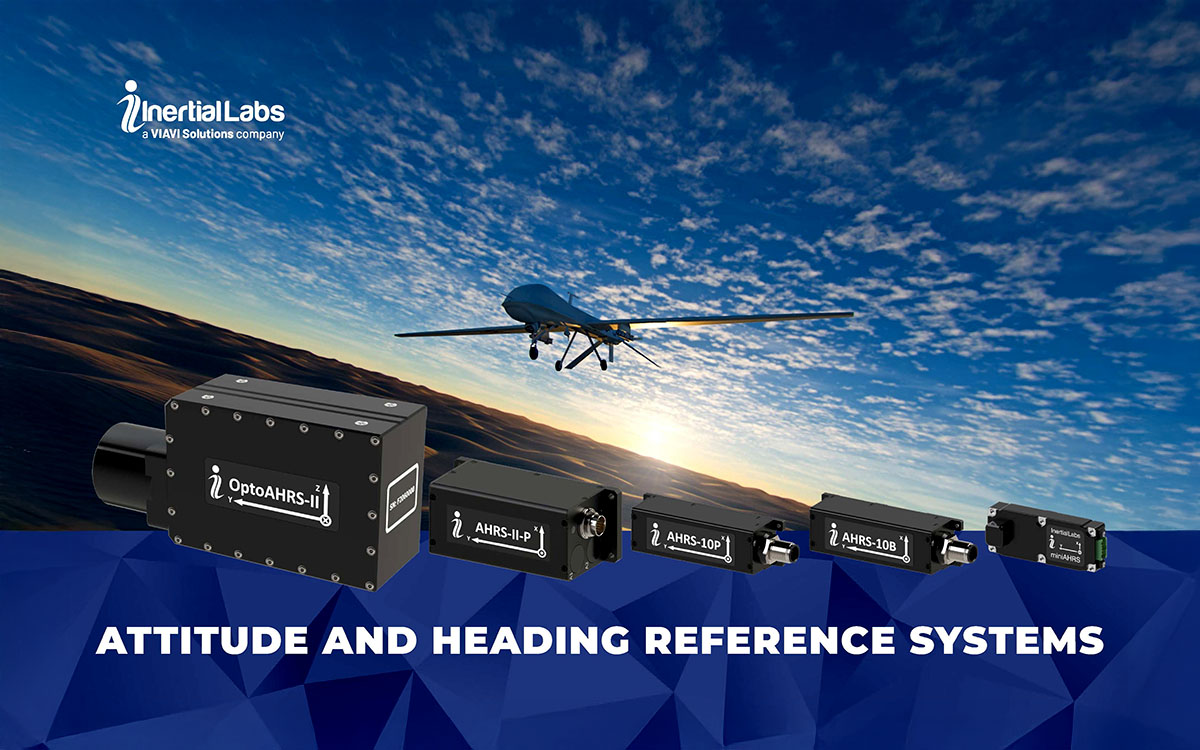
The Inertial Labs AHRS family includes several variants designed to support a range of use cases:
- MiniAHRS: Compact, lightweight unit suitable for space-constrained platforms such as quadcopters, robotic arms, and micro air vehicles.
- AHRS-II: A mid-tier unit with expanded interface options (RS-422, CAN), magnetic field calibration support, and GNSS compatibility.
- OptoAHRS-II: Designed for ground-based targeting and observation systems, this version includes an optical channel and is primarily used in military mortar systems for camera-based visual alignment and tracking.
The modularity of the product range allows customers to choose the level of performance, interface, and data output required for their mission – without compromising SWaP demands for unused functionality.
Looking Ahead: AHRS and Evolving Sensor Fusion
While AHRS systems today are built on mature filtering technologies such as the Kalman filter, future enhancements are already in view. Inertial Labs continues to refine its proprietary sensor fusion algorithms, with a focus on improving accuracy, adaptability, and resistance to interference.
Longer term, we will see greater adoption of AI-enhanced sensor fusion and deeper multi-sensor integration — where AHRS systems adapt dynamically to changing conditions. While these capabilities are still in early-stage research, they signal that even a relatively mature technology like AHRS continues to evolve.
Conclusion
AHRS technology serves as a reliable and efficient middle tier between basic IMUs and fully integrated INS systems. For aviation applications, from small UAVs to manned aircraft, AHRS offers an accessible, proven way to monitor platform orientation in real time. With a balance of accuracy, simplicity, and integration flexibility, it remains a core component of modern flight control and autonomy architectures.
For customers looking to add robust orientation sensing without the full complexity of inertial navigation, AHRS remains a smart and scalable choice.